Rethinking JD-Resume Matching: The Shift from Keyword Matching to AI


What is AI Resume-JD Matching?
AI resume-JD matching is the automated process of comparing a candidate's resume against a job description using machine learning and Natural Language Processing (NLP) to assess fit. Unlike keyword-based systems that scan for exact word matches, AI matching evaluates the context, relevance, and depth of a candidate's experience against the true intent of the role.
Key capabilities
- Contextual understanding: Reads what a candidate has done and in what capacity, not just whether a keyword appears
- Semantic analysis: Recognises that "built scalable data pipelines" and "Python development" describe the same skill cluster
- Match scoring: Assigns each resume a percentage score (e.g., 72%) showing how closely it aligns with the job description
- Skill gap identification: Surfaces exactly what is present and what is missing, so recruiters make shortlisting decisions in seconds, not hours
- High-volume processing: Screens and ranks 100 resumes in under two minutes, compared to 12 to 15 recruiter hours using manual review
Who uses it?
Recruiters screening high volumes of applications, HR teams integrating AI into existing ATS workflows, and candidates optimising their resumes before applying.
A recruiter posts a senior data analyst role. Within 48 hours, 280 resumes come in. Their ATS filters it down to 31. Of those 31, only 9 are actually worth interviewing.
The other 249 candidates? Most were never seen by a human. Because they just did not use the right words. This is what keyword-based resume screening does at scale. It reads words and rewards candidates who mirror the job description instead of genuinely fitting the role.
JD-resume matching is the process of comparing a candidate's resume against a job description to assess how well they fit the role. For years, most hiring platforms did this by scanning for exact word matches. That system made sense when hiring volumes were manageable, but not anymore.
AI-powered JD-resume matching replaces keyword scanning with contextual analysis. It uses Natural Language Processing (NLP) and machine learning to understand what a candidate has done, in what context, at what level, and whether that maps to what the role actually needs.
This blog explains how it works, where keyword systems fail, and what the shift to AI means for your hiring process.
Why Traditional Keyword Matching Falls Short
1. Surface-Level Matching Ignores Skill Proficiency and Relevance
Traditional systems treat all keyword matches equally; they can’t judge how proficient a candidate is at a skill, how recently they used it, or how relevant it is to the role today.
- A candidate who briefly used “Python” five years ago gets ranked similarly to an expert Python developer currently leading AI projects, because both resumes mention “Python.”
- There’s no distinction between passive exposure and deep expertise.
2. Inability to Recognize Emerging Skills or Career Progression
Traditional JD-resume matchers rely on rigid keyword libraries built on static job descriptions. They struggle to:
- Identify candidates with adjacent skills (e.g., someone skilled in “Figma” and “UX writing” being a great fit for a “UI/UX Designer” role).
- Recognize career growth (e.g., a candidate moving from sales to product management shows adaptability and cross-functional expertise).
- Spot new or evolving skills (e.g., prompt engineering, AI integration, no-code tools).
3. ATS Parsing Failures on Non-Standard Resume Formats
Many strong candidates today use resume builders like Canva, Figma, or graphic design platforms that produce visually formatted documents. These resumes often include columns, tables, icons, and embedded images.
- Standard keyword-based ATS systems cannot parse these layouts reliably.
- Text gets skipped, sections get misread, or the entire resume fails to process.
The result: a candidate who took the time to present their experience clearly gets filtered out because the system could not read their file.
The Business Cost of Inaccurate Matching
Poor JD-Resume matching impacts business outcomes. They add up to a systemic problem with measurable consequences for hiring quality and speed.
- High Cost-per-Hire: Filtering mismatched resumes wastes recruiter time.
- Lower Quality-of-Hire: Candidates that look good on paper but don’t match role context end up underperforming.
- Candidate Drop-Off: Great candidates are overlooked simply because their resumes don’t use the “right words.”
A Jobvite study found that 75% of resumes submitted through Applicant Tracking Systems (ATS) are never seen by human eyes due to improper keyword optimization.
This is where AI can truly flip the script.
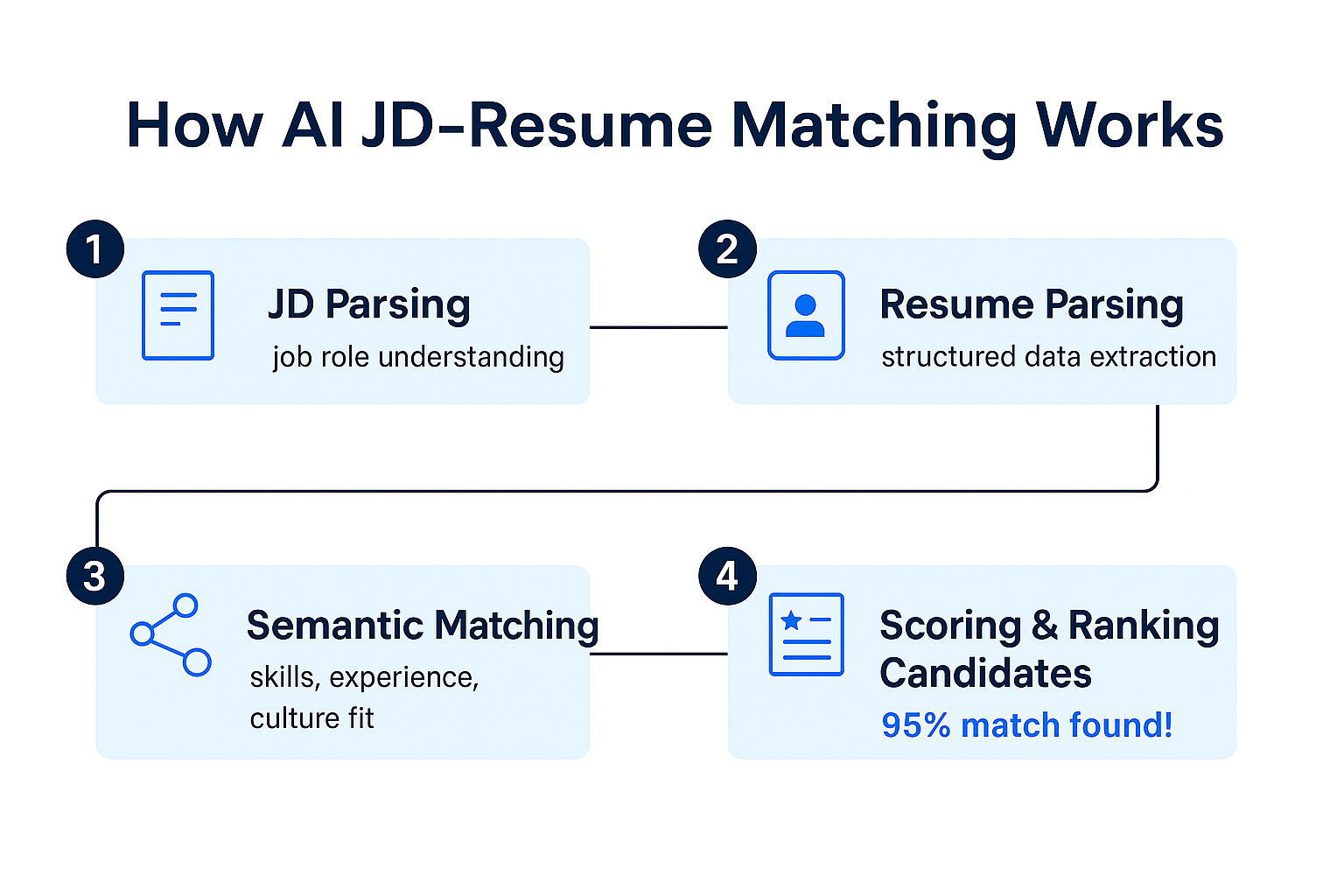
How AI JD-Resume Matching Works
The process is straightforward to understand, even if the technology behind it is not.
Step 1: Document Input
A recruiter uploads a job description and a set of resumes. Modern AI matchers accept PDF, DOCX, and plain text. Some tools, including Recrew, also parse resumes from LinkedIn profiles and ATS databases directly.
Step 2: Parsing and Structuring
The AI reads both documents. It extracts structured data from the resume: job titles, skills, years of experience, industries, education, and notable achievements. It does the same for the job description: required skills, seniority expectations, responsibilities, and implied competencies that are not always stated directly.
Step 3: Semantic Similarity Analysis
This is where AI matchers separate themselves from keyword systems. Instead of looking for identical words, the system calculates how conceptually similar the resume content is to the job description. A resume that mentions "managed cross-functional teams to deliver a $2M infrastructure project" and a JD that asks for "senior project management experience" are semantically aligned, even without a single word in common.
Step 4: Match Scoring
Each resume receives a percentage match score. Recruiters see a ranked shortlist, not a pile of equal-weight results. A score of 85% means the candidate's profile strongly aligns with the role's requirements. A score of 40% flags a significant gap that warrants review before investing interview time.
Step 5: Skill Gap Identification
With skill gap analysis, the system surfaces exactly what is present and what is missing. A recruiter reviewing a 72% match can see: "Candidate has Python, SQL, and 4 years in fintech, missing required experience with Tableau." That is a decision they can make in 10 seconds instead of reading three pages.
This five-step process replaces what previously took a recruiter 12 to 15 hours per role and compresses it to under an hour without sacrificing accuracy.
Why AI Resume Matching Outperforms Keyword Systems?
AI matchers like Recrew.ai go far beyond text scanning. They apply Natural Language Processing (NLP), machine learning, and contextual analysis to understand both resumes and job descriptions the way a human would, but faster and at scale.
1. Intent-Based JD Analysis
AI-powered matchers analyze job descriptions by focusing on the true intent behind a role, not just matching listed keywords. They interpret responsibilities, seniority, and desired outcomes to find candidates who align with the business goals.
A report by McKinsey found that hiring for skills is 5x more predictive of job performance than hiring for education and more than 2x more predictive than hiring for work experience.
2. Contextual Resume Parsing
AI parsers don’t just read resumes, they understand them. They identify not just what a candidate has done, but in what capacity, duration, and industry context.
Example:
- Traditional parser: Matches the word “data analysis” without understanding the context of its use.
- AI parser: Recognizes “Led a team in predictive modeling for healthcare operations” as senior-level, domain-specific experience.
3. Semantic Understanding
Instead of matching the word "Python," an AI matcher understands that "Django," "Flask," and "data pipelines" are part of the same skill cluster. It interprets related concepts and ranks candidate relevance based on the full picture, not a single term.
Key Use Cases in Action
1. High-Volume Recruiting
Companies hiring for BPOs, retail chains, or seasonal roles often receive thousands of resumes for a single opening. AI-powered resume parsers and matchers can process and evaluate massive volumes of resumes in seconds by extracting structured data, analyzing skills, and matching candidates against job requirements automatically.
AI increases recruiter productivity by 60%, according to a study by McKinsey. This scalability allows recruiters to focus on human judgment where it matters most, rather than manual screening.
2. Skill-Based Hiring
With the shift toward skills-first hiring, AI matchers shine by:
- Extracting both hard and soft skills from resumes and JDs
- Identifying competency clusters instead of isolated skills
- Matching candidates based on learnability and adjacent skills
For instance, a candidate who hasn’t used HubSpot but has extensive experience in Salesforce and email marketing tools may still be a strong fit, AI sees the correlation, keyword matching doesn’t.
Know more about this here: Skills-Based Hiring: Why 67% of Fortune 500 Companies Are Making the Switch
3. Diversity Hiring
By focusing purely on skills, experience, and role-specific competencies, the AI ranks candidates based on their true fit for the job and not unconscious biases tied to identity.
This promotes meritocratic shortlisting at scale, helping companies build more diverse, qualified, and equitable talent pools.
4. Resume Optimisation Before Applying
Candidates use it on the other side of the process to understand how well their current resume positions them for a specific role before they apply.
- A candidate targeting a role at a company can upload their resume alongside the job description and receive a match score, say, 61%.
- The system then shows them exactly what is present and what is missing.
- The candidate adjusts their resume to reflect the relevant experience they do have, but had not highlighted.
The result is a stronger application, a better-prepared candidate, and fewer mismatches between what the recruiter expects and who shows up for the interview.
Recrew's free matcher is used this way by both recruiters screening at scale and by candidates optimising individual applications before submission.
How AI Matching Fits Into Your Existing Recruitment Workflow
Most HR teams do not want to rebuild their tech stack to add AI matching. They want it to fit into what they already use.
1. Seamless Integration via Resume Parser APIs
Resume parser APIs are the backbone of modern HR tech. They can be plugged into your existing ATS or Recruitment CRM to deliver structured, searchable candidate profiles within milliseconds. This automation ensures no resume falls through the cracks.
2. Scalability and Learning
AI matchers continuously learn from recruiter feedback. The more you use them, the more accurate they get, improving match rates, conversion ratios, and ultimately hiring velocity.
3. Improved Application Conversion Rates
AI-powered job matching systems enhance application-to-interview ratios by intelligently aligning candidate profiles with job requirements in real-time. For instance, Electrolux implemented an AI-driven recruitment platform that led to an 84% increase in application conversion rates, significantly reducing incomplete applications and time-to-hire.
Explore this in detail here: Why CTOs Should Invest in Resume Parser APIs for HR Automation
The Recrew.ai Edge
Unlike traditional tools, Recrew.ai’s JD-Resume matcher is:
- Context-Aware: It reads between the lines of both resumes and JDs.
- Domain-Trained: With dynamic learning systems tailored for different industries like tech, healthcare, and finance.
- Integrated-Ready: Offers robust Resume Parser APIs for fast, reliable integration with your HR tech stack.
Whether you’re a startup looking to hire your first 10 employees or a large enterprise processing thousands of applicants, Recrew’s matcher helps you move fast without compromising quality. Your first 50 matches are on us! No hidden cost. Recrew it NOW!
Measuring Success: ROI That Speaks Volumes
Here’s how organizations quantify the impact of switching to AI-powered JD matching:
When AI matchers eliminate guesswork, recruiters can focus on what they do best: engaging people and making smart hiring decisions.
Conclusion: The Practical Case for Switching to AI Matching
Keyword-based resume screening made sense when hiring volumes were lower and job descriptions were simpler. Neither of those conditions holds today.
A recruiter using a keyword-based ATS is making decisions based on incomplete information, whether a candidate used a specific word, not whether they can do the job. That gap between word presence and actual capability is where good candidates get lost, and poor matches get through.
AI resume matching closes that gap. It reads context, not just content. It surfaces the candidate who described five years of hands-on Python development as "built scalable data pipelines for healthcare clients," the one a keyword scanner would have missed entirely.
Recrew's AI-powered JD-resume matcher processes your first 50 matches for free with no setup required. Upload a job description, upload your resumes, and see ranked candidates with match scores and skill gap breakdowns in under two minutes.
See what your shortlist looks like when context replaces keywords. Book a demo
FAQs
Q1: What is the difference between AI resume matching and keyword matching?
Keyword matching scans for exact word overlap between a resume and a job description, regardless of context, proficiency, or relevance.
AI resume matching uses semantic analysis to understand the meaning and context behind both documents. It recognises that "Spring Boot" and "Java backend development" are related, even if the exact words differ, and scores candidates based on actual fit rather than word frequency.
Q2: What does a JD-resume match score mean?
A match score is a percentage that represents how closely a candidate's resume aligns with a specific job description. A score of 85-95% indicates strong alignment across skills, experience level, and role context. A score below 60% typically signals either a significant skills gap or that the candidate's experience is described in ways that do not map clearly to the role's requirements.
Match scores are a starting point for shortlisting, not a final hiring decision.
Q3: How long does AI JD-resume matching take?
Modern AI matchers process a resume against a job description in seconds. For high-volume hiring, a batch of 100 resumes can be scored and ranked in under two minutes. Compared to manual screening, which averages 12 to 15 recruiter hours per role, the time saving is substantial.
Q4: Can AI matching handle resumes in different formats?
Yes, AI-powered resume parsers are built to handle PDF, DOCX, and plain text files. Advanced systems can also extract data from visually formatted resumes created in tools like Canva, which traditional keyword-based ATS systems often fail to parse correctly.